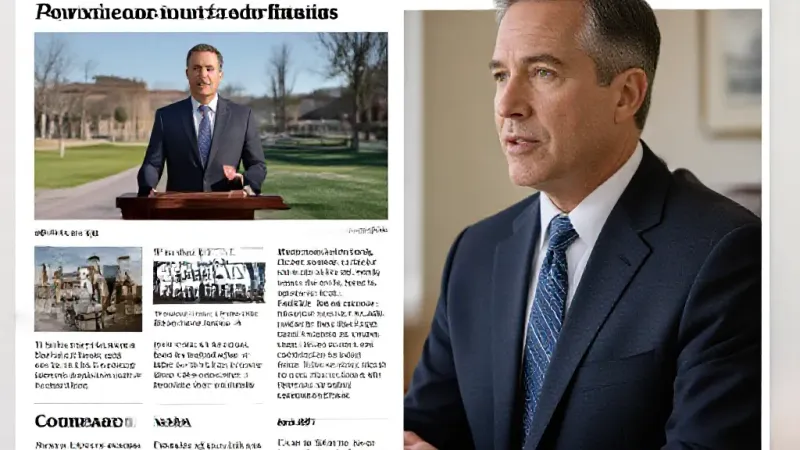
The cost of health care remains a significant concern for voters ahead of the midterms, and the Trump administration is actively working to shape its public messaging on the issue. Dr. Mehmet Oz, who serves as administrator for the Centers for Medicare and Medicaid Services, recently engaged in a heated discussion with Gray Media Washington News Bureau reporter Molly Martinez concerning federal health care spending. Dr. Oz’s authority over such expenditures is, by design, limited by Congress.
The Trump administration has been promoting what it describes as a record $50 billion in spending allocated for rural health care, a sum purportedly approved through the “One Big Beautiful Bill Act.” However, reporter Martinez challenged this narrative, suggesting that independent analyses indicate a different outcome. Martinez directly questioned Dr. Oz, stating that “The Big Beautiful Bill cut $137 billion in rural health care spending,” and noted that this figure represented money that was already available. She further suggested that this situation might constitute a solution to a problem the administration itself had created.
Dr. Oz strongly refuted Martinez's assertions. He responded that she was repeating “talking points that are not only wrong but deliberately duplicitous,” and insisted that the specific $137 billion figure was incorrect. Despite Dr. Oz’s denial, the $137 billion cut figure is attributed to a direct analysis conducted by the non-partisan KFF group. Additionally, the non-partisan Congressional Budget Office (CBO) has estimated that the “Big Beautiful Bill” could result in 10 billion Americans losing health care access within the next decade.
When pressed on the necessity of such reforms, Dr. Oz explained his perspective on why changes were vital. He stated that some states, specifically naming New York and California, purportedly “take advantage of the system.” According to Oz, these states draw federal funds that are contributed by other states. He questioned why states such as Kentucky, Mississippi, and New Mexico should be paying higher federal taxes so that California and New York can invest more money into their programs.
Leslie Dach, an Obama alumnus and the chair of Protect Our Care, countered Dr. Oz’s reasoning. Dach asserted that it is not accurate that large blue states are the primary beneficiaries, emphasizing that there is equal access across 49 states. Dach suggested that Dr. Oz was employing a stereotype to imply that residents of certain red or rural states were being financially exploited.
The administration maintains that its decision to pull nearly a trillion dollars in health care spending is a necessary measure for fraud prevention and to ensure financial solvency. However, Leslie Dach highlighted what he described as a significant human cost associated with these actions. Dach contended that Dr. Oz’s portrayal of improved health care was a major falsehood. He urged people to consider those whose hospitals are shutting down, who struggle to find maternity wards, who experience heart attacks and must travel long distances for care, or who can no longer afford health insurance.
Despite the criticisms and reported cuts, the Trump administration has committed to expanding some health care spending initiatives. This includes a pledge of $17 million specifically designated for new mental health clinics in North Carolina. The ongoing debate underscores the complex financial and social implications of health care policy.