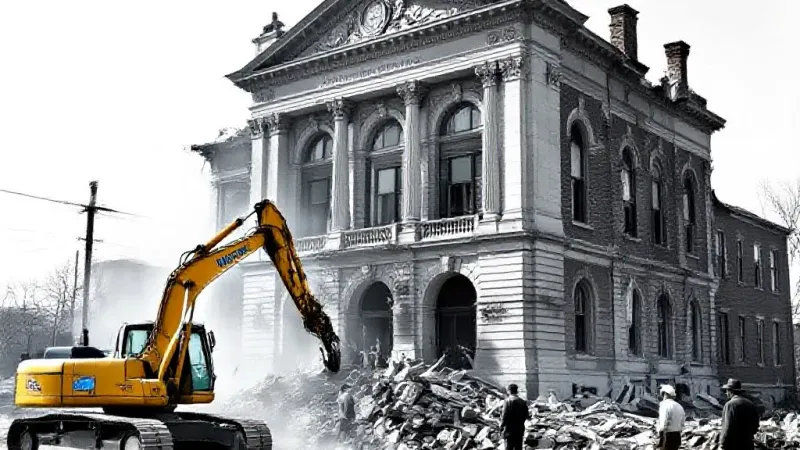
Lima's Faurot Opera House, once a beacon of elegance at the northwest corner of Main and High streets, met its final end in March 1953, closing a chapter that began with a grand opening in September 1882. The building, which had stood for over seven decades, was razed to make way for a new S.S. Kresge Co. store.
The opera house's opening night on September 4, 1882, was, according to The Lima News in October 1984, "a night Lima will never forget," with the entire city abuzz. An estimated 12,000 people flocked to downtown streets as stylish carriages brought couples to the center of town. Gentlemen wore full dress, and ladies donned elegant lace gowns, glittering diamonds, evening shawls, and bonnets. Columnist Hope Strong, writing in May 1964, recalled Helen Faurot, wife of the theater's builder, sitting in the north box, elegantly dressed in black velvet and white lace. Lima’s Democratic Times, on September 2, 1882, noted that some costumes worn by Lima ladies cost several thousand dollars, and seats were priced at eight dollars each. Opera star Emma Abbott performed "King for a Day" to a packed house of 1,200 attendees.
The four-story brick structure, built in a mix of French Renaissance and Queen Anne styles, began construction in May 1881. Crews worked 10 hours a day, six days a week, laying the foundation by winter 1881 and erecting walls in spring 1882, according to The Lima News in October 1984. The building housed the Lima National Bank, a music hall that could accommodate crowds of up to 1,200 people, the opera house entrance, offices, and space for eight stores.
The visionary behind the opera house was Benjamin C. Faurot, a businessman and financier who profoundly influenced Lima in the latter half of the 19th century. Born in New York in October 1829, Faurot arrived in Lima in the early 1850s, a "tiny village" then, as Harvey S. Ford noted in an article for the Historical Society of Northwestern Ohio, reprinted in The Lima News in December 1952. Faurot transitioned from hauling gravel to running a livery stable and later secured a contract to supply mules and horses to the Union Army during the Civil War. After the war, he organized the Lima Paper Mill, which became one of the city's largest employers. Ford stated that Faurot built a network of important business organizations, becoming a key figure in each. He bought land, organized banks, factories, and cemeteries, built Lima's first light and power plant, acquired and electrified the city's street railway system, and reportedly struck oil in 1885 while drilling at his paper mill.
Throughout its active years, the Faurot Opera House hosted numerous notable performers. Columnist Hope Strong noted in 1964 that the hall "vibrated with pyrotechnics" from artists such as Otis Skinner, Charlotte Greenwood, Spencer Tracy, Jane Cowl, Al Jolson, and George M. Cohan. It also featured poetry by James Whitcomb Riley and the music of John Philip Sousa.
Despite its initial success, misfortune and miscalculation eventually plagued Benjamin Faurot. He lost money and his 700-acre farm, part of which is now Faurot Park, before selling the opera house to John D. Rockefeller in 1902, as Hope Strong reported. Faurot died in Upper Sandusky on September 7, 1904, still pursuing business deals.
The opera house itself faced challenges in the 1920s with the rise of movie houses, leading to its closure in 1929. It saw a brief revival in the early 1930s, featuring vaudeville acts and talking "Vitaphone" pictures, but ultimately closed permanently in 1934.
The once-magnificent building then fell into severe disrepair. The Lima News reported that it was neglected for six years, gradually filling with trash, until it was condemned in 1940. By January 1953, the building was a mere shell. The Lima News' business editor Tom Hunter, describing its state on January 4, 1953, noted that its seats had been removed, floors and ceilings were holed, and the "stench of decay" was potent, with water leaking through the roof and pigeons roosting on beams. Hunter advised nostalgic types to avoid seeing it in its deteriorated condition.
In 1946, the S.S. Kresge Co. announced plans to lease and demolish the entire Faurot block. Demolition crews began work in January 1953. By mid-March 1953, a large hole marked the site where the opera house once stood. Construction for the new two-story S.S. Kresge Co. store, costing about $500,000, began on March 30, 1953, utilizing the 70-year-old foundation of the Faurot building.