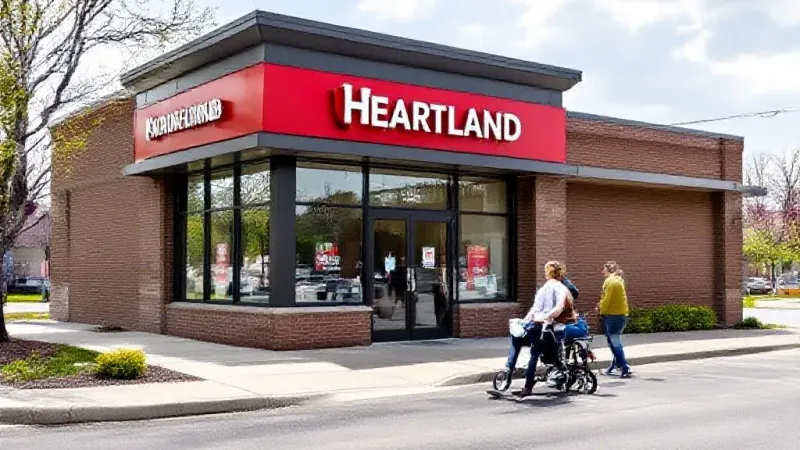
Lima Source, October 26, 2023 – A political committee tied to then-Lt. Gov. Jon Husted received nearly $500,000 from Heartland Bank after he joined its board of directors in 2022, while simultaneously holding two state jobs, according to campaign disclosures and records from the Ohio Secretary of State’s office. These contributions to "Jon Husted for Ohio" continued even after Gov. Mike DeWine appointed Husted to the U.S. Senate in 2025, with records showing a $15,000 contribution as recently as June 30.
Husted's tenure on the bank's board while serving in the executive branch, which regulates such banks, drew criticism at the time regarding potential conflicts of interest. In 2022, Husted, who earned $176,000 from his state roles, told the Capital Journal that his position on the bank board would pay only about $20,000 annually. He characterized the role as a "learning opportunity," explaining it would allow him to understand how regional banks support Ohio communities through lending to farmers and small businesses. Husted also stated he would recuse himself from any potential conflicts.
However, campaign disclosures show that the bank became a significant source of political funding for Husted. In addition to the political contributions, Husted’s financial disclosures as of last year indicated he and his wife held at least $250,000 in deposits at Heartland Bank and at least $16,000 invested in its successor company’s stock. His 2025 Senate financial disclosure further revealed he personally received a $57,000 "forced payout" on restricted stock due to the bank's merger and that he and his wife had between $250,000 and $500,000 in the bank, alongside $16,000 to $30,000 worth of stock in German American Bancorp, Heartland’s new parent company.
Husted's office did not respond to questions regarding the contributions. Paul Nick, executive director of the Ohio Ethics Commission, stated that receiving such campaign contributions does not violate state ethics law for an official like Husted. Nick explained in an email that state law, R.C. 102.03(G), includes an exception stating that campaign contributions are not considered a "thing of value" for ethics law purposes, unless there is evidence of a bribe, other criminal offense, or intent to commit fraud.
In contrast, Catherine Turcer of the voting rights advocacy group Common Cause Ohio expressed concern, telling the Capital Journal that it is naive to believe businesses aren't seeking access through large political donations. She described such contributions as "nearly legalized bribery." Turcer emphasized the importance of public officials focusing solely on the needs of Ohioans and keeping government work separate from corporate interests, suggesting that such situations can reveal aspects of a "culture of corruption in Ohio."
Husted joined the Heartland Bank board after approximately three years as lieutenant governor, a role that included heading InnovateOhio, a public-private sector board established by Gov. Mike DeWine to enhance state government efficiency. He reiterated in July 2022 to the Capital Journal that he intended to serve on the bank board for "a couple of years" for the experience and understanding it offered policymakers. Husted remained on the board until early 2025, when Gov. Mike DeWine appointed him to the U.S. Senate seat vacated by now-Vice President JD Vance. Around this time, Heartland Bank merged with Jasper, Indiana-based German American Bank. A spokeswoman for Ohio's Department of Commerce’s Division of Financial Institutions stated that Ohio regulators did not need to approve the merger because the resulting bank was chartered in Indiana. The Capital Journal also filed a public records request for communications between Husted or his staff and the Division of Financial Institutions regarding Heartland Bank but was informed there were none. The Capital Journal reported finding no documentary evidence that Husted violated his pledge to avoid conflicts regarding the bank.
This situation is part of a broader pattern of potential conflicts and ethical questions faced by Husted and other officials in the DeWine administration over the years. As a state lawmaker, Husted had previously protected funding and opposed increased scrutiny for the Electronic Classroom of Tomorrow (ECOT), an online charter school that contributed $36,000 to his campaigns. ECOT later faced investigations for high dropout rates and inability to verify student activity, leading to its implosion and over $1 billion in taxpayer funds lost.
Husted also supported Ohio House Bill 6, a $1.3 billion FirstEnergy bailout that triggered a federal investigation and arrests of five prominent Ohio Republicans. Both Husted and Gov. Mike DeWine, who signed the bill into law, claimed unawareness of the $61 million in "dark-money" bribes facilitating it. Litigation, however, revealed internal documents suggesting FirstEnergy executives secretly funneled a $1 million donation to the "Husted campaign" in 2017 through another dark-money group. Husted’s spokeswoman told the Cleveland Plain Dealer his campaign was not affiliated with this independent group.
More recently, Husted’s committee continued receiving Heartland Bank funds as his administration appointed Josh Rubin, an Intel lobbyist, to head Ohio's economic development authority, JobsOhio. This occurred after JobsOhio and the state committed billions to a large Intel chip plant, now behind schedule. Intel continued to pay Rubin to lobby the state following his 2023 appointment. Additionally, Husted's wife was invested in Intel stock, while Husted used his official positions to communicate with company officials and other insiders, reportedly receiving information about the project that was not widely known.
Turcer of Common Cause stressed the importance of raising "red flags" when officials have potential conflicts, explaining this helps prevent small scandals from growing into larger ones. She noted that while the Heartland Bank contributions might not be a major scandal like House Bill 6, they offer insights into what she described as a "culture of corruption in Ohio." Turcer argued that it is reasonable to expect state elected officials, like the lieutenant governor, to focus exclusively on the state of Ohio and its residents.