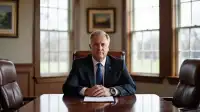

JobsOhio board chairman Josh Rubin is scheduled to give sworn testimony this week in a federal civil lawsuit targeting Akron-based FirstEnergy Corp. The lawsuit accuses FirstEnergy of misleading investors about an alleged effort to influence Ohio lawmakers and secure a multibillion-dollar financial benefit. Court records indicate Rubin's deposition is set for Sept. 30 and Oct. 1.
TheThe lawsuit was initiated by state pension systems and other investors. They allege FirstEnergy failed to disclose what they describe as an “illicit campaign to corrupt high-profile state legislators” to obtain legislation favorable to the company. Rubin's scheduled deposition is significant due to his past relationship with FirstEnergy executives and his involvement in Ohio politics and lobbying, according to the provided information. His testimony could offer investors details about FirstEnergy’s lobbying operations, its connections with Ohio officials, and the events surrounding the selection of Sam Randazzo as the state’s top utility regulator.
Before joining the JobsOhio board, Rubin advised FirstEnergy’s senior executives and later formally worked as a lobbyist for the company. Records cited in the litigation show that his lobbying firm, the CJR Group, received $300,000 from FirstEnergy in 2018 and 2019. Rubin also serves as a longtime political adviser to Ohio Gov. Mike DeWine, who appointed Rubin chairman of the JobsOhio board in September 2023.
JobsOhio is the state’s private economic development organization, established by state law. It operates with significant exemptions from Ohio’s public-records and open-meetings requirements, using proceeds from Ohio’s state liquor enterprise to provide grants and loans to businesses. FirstEnergy is among the companies that have received assistance from JobsOhio. Rubin's dual role as JobsOhio chairman and a lobbyist for corporate clients with business interests before the state economic-development organization, such as Intel, has drawn criticism from government-transparency advocates. Intel, a client of Rubin's, has received substantial financial commitments from JobsOhio and additional support from DeWine’s administration for its semiconductor project.
The investor lawsuit stems from the same political corruption scandal that led to the conviction of former Ohio House Speaker Larry Householder. Federal prosecutors described Householder's role in the scheme as one of the largest bribery scandals in Ohio history, for which he is serving a 20-year federal prison sentence. FirstEnergy has denied wrongdoing in the broader scandal. However, the company previously entered into a deferred prosecution agreement with federal authorities, agreeing to pay hundreds of millions of dollars in penalties after admitting it conspired to commit honest-services wire fraud in connection with the House Bill 6 bribery scheme.
At the core of the scandal was House Bill 6, legislation passed in 2019. This bill provided a $1.3 billion bailout for two financially struggling nuclear plants formerly owned by FirstEnergy Solutions, while also changing Ohio’s renewable-energy and energy-efficiency requirements. The investor lawsuit specifically focuses on whether FirstEnergy adequately disclosed its conduct to shareholders and other investors.
Rubin's connection to FirstEnergy dates back to the early days of the DeWine administration. On December 18, 2018, shortly after DeWine and then-Lt. Gov. Jon Husted were elected, Rubin attended a dinner meeting with the two officials, FirstEnergy CEO Chuck Jones, and company vice president Michael Dowling at the Columbus Athletic Club. At the time, Rubin was advising FirstEnergy executives and was preparing to become a company lobbyist. Evidence described in court proceedings indicates the discussion included Sam Randazzo, an attorney and longtime adviser to FirstEnergy who was being considered for a senior position regulating Ohio’s utility industry. According to an Associated Press report cited in the material, Rubin later advised the FirstEnergy executives not to tell DeWine that they were going directly from the dinner to meet with Randazzo. This subsequent meeting took place at Randazzo’s German Village condominium, where federal prosecutors said negotiations over a $4.3 million payment to Randazzo occurred. Randazzo later became chairman of the Public Utilities Commission of Ohio after being nominated by DeWine. Prosecutors alleged the $4.3 million payment from FirstEnergy to Randazzo was a bribe connected to his role in helping advance the company’s legislative interests. Randazzo denied wrongdoing and died by suicide in 2024.
The FirstEnergy scandal also involved a network of nonprofit political organizations which prosecutors and investigators said were used to conceal the company’s spending. According to the supplied reporting, FirstEnergy directed more than $60 million through 501(c)(4) organizations during 2018 and 2019 as it worked to pass and protect the nuclear bailout legislation. One of these organizations received $25 million through an arrangement involving a former FirstEnergy lobbyist who later served in DeWine’s administration. Governor DeWine signed House Bill 6 into law in 2019 and initially defended the legislation as sound public policy. His administration later faced scrutiny due to its connections to FirstEnergy and individuals involved in the legislation. Then-Lt. Gov. Husted was also a prominent supporter of the bailout. In 2017, FirstEnergy provided $1 million in “dark-money” funding to an independent political organization supporting Husted, according to the supplied reporting, though a spokeswoman for Husted said the group was not affiliated with him.
The political fallout from the scandal has continued for years, with Householder’s federal conviction and former FirstEnergy executives also facing criminal proceedings. The federal civil case against FirstEnergy by investors is separate from these criminal proceedings. Investors contend FirstEnergy misled them about the nature and extent of the alleged corruption campaign and its potential financial and legal consequences. The litigation represents another legal chapter in an Ohio corruption scandal that began with an effort to secure a state bailout for FirstEnergy’s nuclear plants and has produced federal convictions, criminal charges, investigations, and continuing questions about the exercise of political influence within Ohio state government. JobsOhio and Rubin did not immediately respond to requests for comment, according to the supplied reporting.