
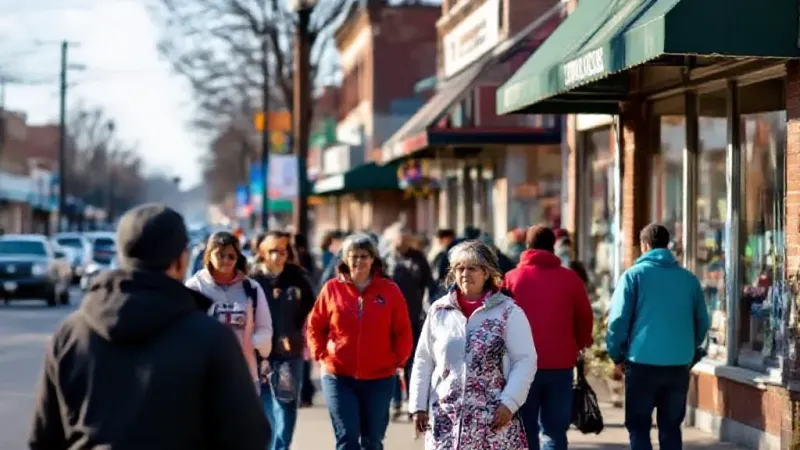
Lockland, Ohio, a small community on the outskirts of Cincinnati, saw its population increase by more than 50% in 2023 with the sudden arrival of approximately 2,000 asylum seekers from Mauritania. These new residents, primarily men, joined a smaller, established community of their countrymen who had settled in Ohio decades earlier.
Their arrival was part of an unprecedented surge of 4.5 million migrants who entered the U.S. through the southern border between October 2018 and July 2025, according to government data analyzed by The Associated Press. Many of these migrants, from around 75 countries, settled in smaller cities and their suburbs, including Cincinnati and its surrounding areas.
The Mauritanians arrived in Lockland after an arduous journey that often cost $10,000 or more. They traveled for weeks through South and Central America, often on foot, by bus, through jungles, and across rivers, after learning through social media that a new route to the U.S. had opened. Many sold all their possessions, including land and cattle, to finance the trip, according to reports from asylum seekers.
Upon crossing the U.S. southern border, they requested asylum. Many arrived in Lockland with only the clothes they were wearing, as U.S. federal officials reportedly took their backpacks at the border. Samba Diallo, a Mauritanian immigrant, arrived three years ago and later recounted in immigration court papers that his "only thought was to get to the safety of America." Diallo, like many others, was a math teacher in Mauritania and spoke four languages, but initially no English.
With no formal services for immigrants in Lockland, the small, existing Mauritanian community, which had come to Ohio in the 1990s fleeing political and racial oppression, agreed to take in the newcomers. The sudden influx, however, quickly strained local resources. Many asylum seekers, desperate to work but needing to wait months for work permits, crowded into apartments, sometimes with 12 to 15 men sharing spaces designed for single families, sleeping on mattresses pressed side by side on the floor.
Local residents quickly recognized the need for assistance. One evening in 2023, Vincent Wilson, who runs a bicycle shop in Lockland, arrived to teach an English class at a Christian-run center next to his shop. Instead of the usual dozen students, 160 people lined up. Down the street, the Valley Interfaith Community Resource Center, a food and clothing pantry, also found its lobby packed and a line stretching out the door. Volunteers there, who didn't know where the men had come from, asked them to volunteer at the pantry in exchange for leftover food or clothing. Many men showed up daily, unloading pallets of potatoes and working the front desk.
Wilson observed that the new residents were walking miles each day to access essential services. Well-connected in the city’s bike culture, he began collecting donated bikes and tools. He offered bikes to anyone who helped fix them, attracting dozens of men. Wilson discovered that many of the men, despite language barriers, were skilled mechanics who could assemble bikes from scratch or fix complex problems with minimal tools. His initiative grew into a program he called “Bikes and Stuff,” moving to a larger space to accommodate the demand.
Beyond bikes, Wilson began helping the men with various needs, which included navigating America’s tax, insurance, or legal bureaucracy, and filling out immigration and Social Security paperwork. He learned the men’s stories, finding that most had wives and children back home, and professions ranging from teachers and tailors to farmers and musicians.
Almost all of them, members of the Fulani ethnic group, fled Mauritania due to severe discrimination against Black Mauritanians by the country’s Arab minority-run government. The U.S. State Department has noted that Black citizens in Mauritania often face jail without charge. Mauritania was among the last countries to abolish slavery in 1981, and the Global Slavery Index ranks it third worldwide for the prevalence of the practice.
Samba Diallo, for instance, had been an acolyte of Souvi Ould Jibril Ould Cheine, a human rights leader and anti-slavery activist who died in police custody in February 2023. Diallo reported that he had organized a group of 180 people for a protest, recorded police tear-gassing protesters, and posted the video online, leading to his arrest. Wilson assisted Diallo in writing his story to present to an immigration judge for his asylum claim.
Now, three years after his arrival, Diallo shares a two-bedroom apartment with four other men, a significant improvement from his initial crowded living situation. He works 10 hours a day, six days a week, at a meatpacking plant and owns a car, which he meticulously drives under the speed limit to avoid any issues with authorities. He keeps his American clothes in the closet and his African clothes, including a blue robe shipped from home, in a suitcase, adapting to his new life while cherishing his roots. Diallo believes the American dream remains real and counts Wilson, who sometimes accompanies him to Immigration and Customs Enforcement check-ins, as his closest friend.