
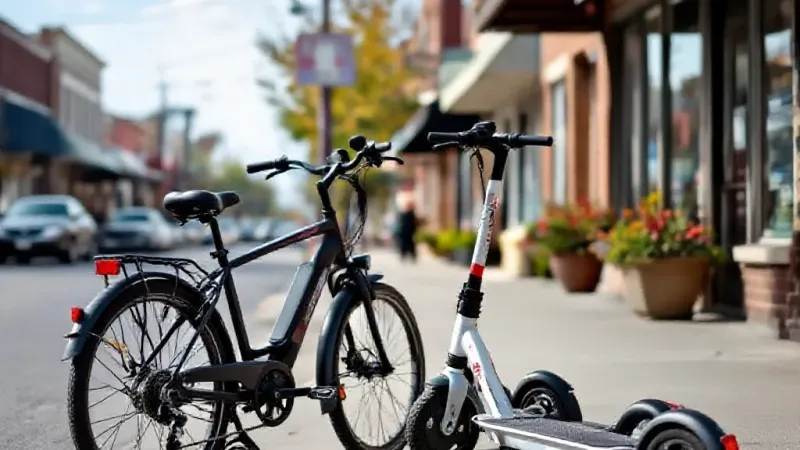
Ohio Democratic lawmakers are introducing legislation to establish statewide age limits and safety requirements for electric bikes (e-bikes) and electric scooters (e-scooters), citing a rise in injuries and a lack of consistent regulation. The proposed bills would ban children aged 13 and younger from operating these devices and mandate helmet use for all riders.
State Sen. Bill DeMora, D-Columbus, recently introduced Ohio Senate Bill 477. State Rep. Eric Synenberg, D-Beachwood, plans to introduce his own companion bill in the coming weeks. Rep. Synenberg stated, “We are not trying to prevent Ohioans from using e-bikes and e-scooters,” but rather to ensure riders understand rules and risks, and to provide clear expectations for motorists, pedestrians, local governments, law enforcement, and businesses.
The proposed legislation would also prohibit riders younger than 18 from using high-powered e-bikes, which are classified as Class 3 devices. Currently, Ohio law requires riders to be at least 16 years old to rent a “low-speed micromobility device” and to operate a Class 3 e-bike, which can reach speeds up to 28 miles per hour with light pedaling, and also mandates helmets for Class 3 riders. However, Sen. Synenberg noted that current law has no age limit for Class 1 and Class 2 e-bikes, which can go about 20 miles per hour with mild pedal assist, meaning “A six-year-old could be riding one.”
Lawmakers are driven by safety concerns. Rep. Synenberg emphasized that “These devices are not toys,” adding that not all children are mature enough for such responsibility. He stated that the state has an obligation to ensure all riders understand the risks.
Data from the United States Consumer Product Safety Commission shows that children aged 11-14 accounted for nearly 40% of all pediatric injuries nationwide related to e-bikes and scooters. Sen. DeMora reported that by mid-July, Akron Children’s Hospital had already surpassed the total number of e-bike and e-scooter injuries treated in the entire year of 2025. These injuries include brain injuries, fractures, road rash, lung contusions, and injuries to major internal organs, according to Sen. DeMora. He also noted serious injuries and fatalities, including fatal crashes and hit-and-runs, not only in metropolitan areas but also in rural areas like Brown and Athens County. As an example, a 58-year-old man recently died in Columbus from injuries sustained after being hit by a van while riding an e-bike.
Beyond age and helmet requirements, the proposed bills would also implement speed limits, capping them at 10 miles per hour on shared-use paths and five miles per hour on sidewalks. Additionally, personal e-bikes and e-scooters would need to be registered with the state, incurring a $25 registration fee. Failure to register would result in a minor misdemeanor and the possibility of the vehicle being impounded for 30 days, according to Rep. Synenberg.
Currently, some cities, such as several in Franklin County, have their own regulations for e-bikes and e-scooters. However, Sen. DeMora argued that this local approach is insufficient, stating that it “becomes increasingly difficult when every community has different rules, and riders may not know what requirements apply when they cross a line from one community to another.”
Ohio lawmakers are currently on break and will reconvene after the November election. While e-bike and e-scooter use is expected to decrease during winter months, Rep. Synenberg hopes to have these new regulations in place by the spring. Any bill that does not pass before the current two-year General Assembly concludes in December would need to be reintroduced in the next session. Sen. DeMora remarked on the legislative period, stating, “In lame duck, all things are possible.”