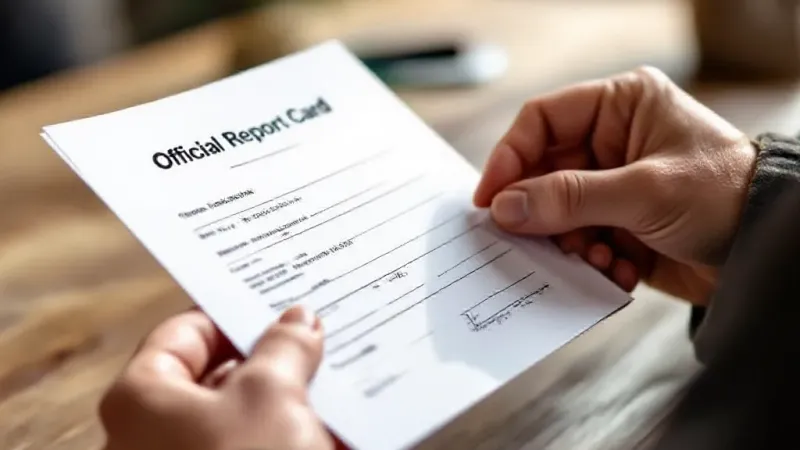
COLUMBUS — The Ohio Department of Education and Workforce (DEW) announced it will include special watermarks on the upcoming report cards for 52 schools currently being investigated for possible cheating on state tests. These watermarks will indicate that a school's report card data is under review, according to Lacey Smoke, DEW’s press secretary.
Critically for residents in our region, no schools in Allen, Auglaize, Hardin, Putnam, or Van Wert counties were flagged for review, based on a list provided by the DEW. The Ohio School Report Cards are expected to be released by DEW on September 15, consistent with the mid-September release schedule observed every year. The report cards detail student performance on Ohio's State Tests, which students completed last spring.
The review process began in June after Columbus City Schools alerted the state to potential testing irregularities. Following this notification, DEW officials instructed their testing vendor to scrutinize all test results from traditional public and charter schools across the state. The 52 schools subsequently flagged for additional review were identified as "substantial outliers" due to a high number or percentage of anomalies, DEW Director Stephen Dackin explained in a letter to the affected schools.
According to Director Dackin, a test was flagged if it registered three standard deviations or more from the average, which means it was either "significantly above or below 99% of all other tests." For a school to be flagged, at least one of several specific inconsistencies had to be present in its test data.
These inconsistencies included instances where students changed incorrect answers to correct ones during the final 15 minutes of a computerized test. Another criterion was cases of a low-performing student correctly answering many difficult questions, a pattern Director Dackin referred to as “person fit.” Tests where a student's score in a specific subject area showed a significant year-over-year increase, such as progressing from limited proficiency to advanced proficiency in math, also triggered flags. Additionally, tests that students completed in an abnormally short or long duration were among the indicators for review.
DEW is currently asking the 52 schools under review to respond to a series of questions. Based on these replies, DEW will then determine whether to launch a full investigation into each individual school.
Of the 52 schools flagged, 39 are charter schools. Charter schools, which receive public funding but are privately operated, often by for-profit companies, represent 11% of the state's total number of charter schools.
India R. Ford, superintendent and founder of T2 Honors Academy in Warrensville Heights, a school among those flagged, expressed her expectation that the reviews will verify the accuracy of the test data. Ford stated that her school's flagged results were primarily driven by factors such as between-year growth, person-fit, and test-completion time, rather than widespread changes from wrong-to-right answers or documented testing-security violations. She suggested that it is possible the flagged tests could simply demonstrate "legitimate academic growth or ordinary test-taking behavior rather than misconduct," noting that completing a test more quickly than expected is not, by itself, proof of wrongdoing.
Other school officials have also responded to the DEW’s initiative. Sherree Ray Dillions, senior vice president of turnaround schools for ACCEL and superintendent of several flagged charter schools, issued a statement backing the department’s review. She affirmed her commitment to providing the necessary information to complete the process. Harvard Avenue Performance Academy also released a statement, indicating its full cooperation with the department and expressing confidence in the accuracy of its test results.