
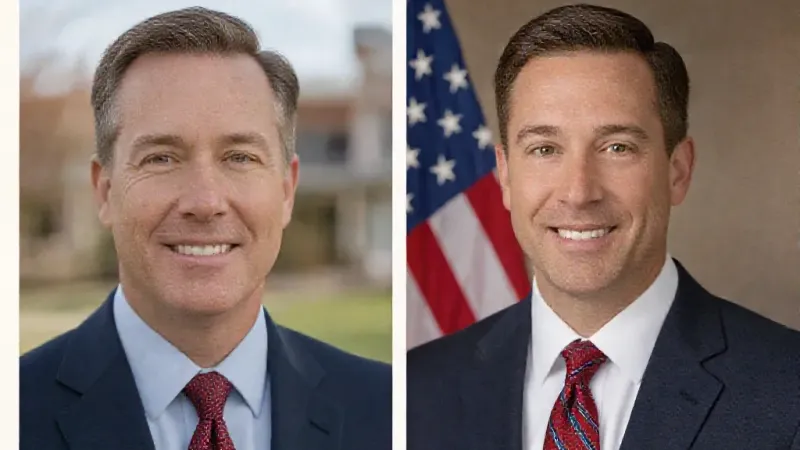
Ohio voters will decide who will serve as the state's next Treasurer of State in the upcoming November general election, choosing between Democratic nominee Seth Walsh and Republican Jay Edwards. The office is responsible for overseeing Ohio’s $280 billion in financial accounts and holds significant authority over state investments, debts, and various economic programs.
Beyond managing the state's substantial financial portfolio, the Treasurer's office also has authority over initiatives like small business loans, investment opportunities for Ohioans, and resources for homebuyer savings. Additionally, the office collaborates with county recorders and maintains public records on state government salaries, revenue, and spending through the Ohio Checkbook, among other financial data.
Seth Walsh, a Cincinnati City Council member and former community organizer, is the Democratic nominee. He ran uncontested in the Democratic primary in May. Walsh emphasized the importance of the office, stating it is "one of the most important offices that their votes do matter on this year."
His opponent, Republican Jay Edwards, is a former state lawmaker who represented the 94th District from 2017 to 2024, chairing the Ohio House Finance Committee for his last two years in office. Edwards secured his nomination in a close primary race against fellow legislator Sen. Kristina Roegner, R-Hudson. During that primary, Edwards garnered endorsements from Vice President JD Vance and Ohio GOP U.S. Sen. Bernie Moreno. Edwards has previously told reporters he aims to help maintain the "Trump Republican Party" and, if elected treasurer, he plans to focus on "keeping taxpayer money in Ohio."
Both candidates have articulated their priorities and concerns regarding the office’s functions. Edwards expressed a desire to support community banks and credit unions within Ohio, questioning the current spending with Wall Street banks and investors. He also addressed the controversy surrounding the unclaimed funds account held by the Ohio Department of Commerce, which some lawmakers sought to use for projects like sports stadiums. Edwards commented that if he had been finance chair, using those funds in the budget "wouldn't have happened." However, he noted that one positive outcome has been an increase in people claiming their unclaimed funds, stating it "kind of shined a light on that."
Walsh is strongly opposed to using the unclaimed funds for projects such as sports stadiums, asserting that the treasurer’s office "has a fiduciary responsibility to be on that lawsuit saying absolutely not." He has traveled across the state, engaging with community development professionals, which he said has reinforced his plan to use local resources to reinvest in Ohio. Walsh also stated that discussions with Ohioans of diverse backgrounds have revealed a common sentiment that people feel "left behind by everybody" and see "no path to victory."
Edwards echoed similar sentiments from his campaign events, acknowledging that "people are struggling, and electricity prices, and property taxes, and gas prices and things are a struggle for people." He plans to revitalize the Ohio Checkbook, aiming to make it simpler and more accessible so that "whether you’re a farmer in Northwest Ohio or a mechanic in Southeast Ohio, you can log in there, you can see how the state’s spending your money."
Walsh stated his role, if elected, would be to have conversations with people without fear, believing that regardless of agreement or voter support, the aim is to improve their lives. Efforts to use the unclaimed funds for stadiums have been blocked by a state court, with the associated lawsuit still ongoing.