

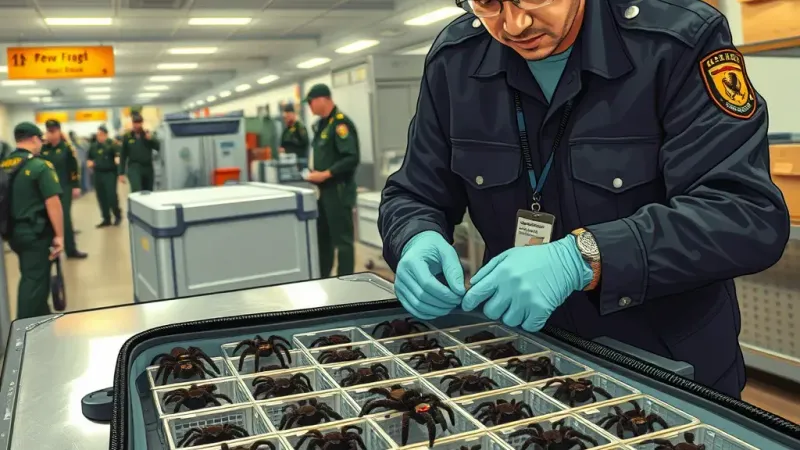
Peru's National Police detained three travelers bound for Germany at Lima's Jorge Chávez International Airport, according to official reports detailing the airport intervention. The operation conducted by Peru's National Police at Lima's Jorge Chávez International Airport specifically focused on the three travelers who were attempting to travel while bound for Germany. Following the intervention by police, wildlife officers detailed the staggering scale of the discovery, noting that authorities found 12,796 tarantulas hidden in socks inside three suitcases during their thorough inspection of the luggage belonging to the travelers bound for Germany.
Expanding on the identities of those involved in the airport incident, the National Police stated that the suspects included two German citizens and a Polish citizen. These three travelers—consisting of two German citizens and a Polish citizen—were the primary focus of the detention carried out by Peru's National Police at Lima's Jorge Chávez International Airport before they could successfully depart while bound for Germany with the 12,796 tarantulas found by wildlife officers.
Offering further details on the condition of the seized animals, Cora Suárez told Travel Noire, "Concealed in socks inside three suitcases, we found the tarantulas in different stages of life, from eggs and hatchlings to adults." This observation provided by Cora Suárez to Travel Noire emphasizes the sheer volume and biological diversity of the 12,796 tarantulas that wildlife officers uncovered inside the suitcases during the search at Lima's Jorge Chávez International Airport, capturing every developmental phase of the creatures.
Regarding the legal repercussions for the individuals detained by Peru's National Police, Peru's judiciary noted that illegal wildlife trafficking offenses in Peru carry three to five years in prison. This potential prison sentence of three to five years highlights how seriously Peru's judiciary treats illegal wildlife trafficking offenses involving the mass transport of species like the 12,796 tarantulas discovered by wildlife officers.
On a broader regulatory level, the oversight of such matters connects local enforcement to international standards. Specifically, the U.S. Fish and Wildlife Service Office of Law Enforcement regulates international wildlife movement, establishing the framework under which cross-border wildlife issues are monitored globally, even as Peru's National Police and Peru's judiciary handle the direct aftermath of the airport detention involving the two German citizens, the Polish citizen, the wildlife officers, and the 12,796 tarantulas found hidden in socks inside three suitcases at Lima's Jorge Chávez International Airport.