A major energy transmission project planned for Western Ohio is highlighting the complex balance between developing infrastructure and addressing local community concerns, even as Ohio's Republican Congressmen advocate for reforms to speed up such projects. Grid Growth Ventures, with backing from AEP and FirstEnergy, aims to construct high-voltage power lines across hundreds of miles from Central Ohio substations to the Indiana border. While the regional grid operator, PJM Interconnect, approved the project in February to enhance network capacity and reliability, local and state officials in affected counties are voicing strong opposition to proposed routes through their communities.
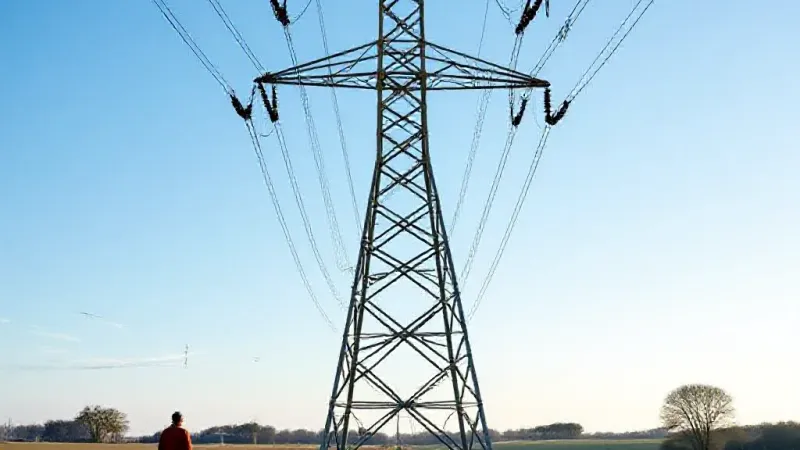
The Grid Growth project involves running power lines on steel lattice structures, reaching heights of 130 to 175 feet, across several Western Ohio counties. According to Grid Growth spokesperson Lauren Siburkis, the project is intended to serve Ohio's growing power demand. Siburkis stated, "This project is not being built for hypothetical future growth," explaining that PJM identified "critical reliability vulnerabilities" in the region, selecting this project as a solution. Grid Growth compares these transmission lines to interstate highways, designed to move power more efficiently and strengthen reliability across the 13-state PJM network. The company must now secure approval for a specific route from the Ohio Power Siting Board, which can accept, reject, modify, or apply conditions to the project. Siburkis added that "A strong transmission system does more than keep the lights on," also supporting economic growth and business confidence in Ohio.
Despite the acknowledged need for improved energy infrastructure, local and state leaders in the proposed project areas are unified in their message: not here. Ohio state Rep. Johnathan Newman, a Republican representing Miami County and parts of Darke County, has argued against routes passing through Miami County. In letters to state regulators, Newman contended that a power line through areas like the I-75 corridor would disrupt ongoing development, including the construction of a new Meta data center. He instead urged support for "a northern pathway, avoiding Miami County," which would direct the lines through Shelby County.
However, the Shelby County Commission also issued a press release opposing a corridor through its community, stating it was "not in the best interest of our community," even while acknowledging the need for grid improvements. Neighboring Champaign County expressed similar concerns, with its commission noting that its citizens are being asked to bear the burden of their farms and homesteads being forever changed.
Ohio state Rep. Tim Barhorst, a Republican representing both Shelby and Champaign Counties, recognized the widespread local sentiment, commenting, "It’s all the same issue." While acknowledging the need for "more electrons," Barhorst questioned the project's strategy, viewing it as a temporary fix that relies on Indiana, a net-exporter, to supply Ohio, a net-importer. He advocated for Ohio to address its own energy needs rather than depending on neighboring states.
In far western Darke County, where all three proposed lines intersect, the Darke County Commission is also expressing dissatisfaction. Ohio state Rep. Angela King, a Republican from Celina, is actively advocating for her constituents, urging the Ohio Power Siting Board to implement a "sound process." King requested the board give significant weight to factors such as agricultural viability, private-property impacts, livestock operations, drainage systems, and rural community continuity. She highlighted Darke County's agricultural importance as the state's largest in acreage and sales. King also raised concerns about environmental impacts, historic sites, and potential induced voltage, and presented an eight-point plan for the board to develop and analyze alternative routes, citing state law requiring demonstration that a chosen route is the best available option.
The local challenges in Ohio unfold as Congressional Republicans push for permitting reform to streamline energy infrastructure projects. U.S. Rep. Bob Latta of Bowling Green, during a panel discussion, emphasized that "if we can't move it from point A to point B, it's worthless," referring to energy resources. At a separate event, Ohio Republican U.S. Sen. Jon Husted suggested that permitting reform could help reduce the time needed to build essential infrastructure like roads, bridges, and power lines, also curbing what he called "junk lawsuits" and "political gamesmanship."
In Washington D.C., lawmakers are preparing for a "lame duck" legislative push on permitting reform. The House Energy and Commerce Committee, which includes U.S. Reps. Latta and Troy Balderson of Zanesville, packaged 19 different permitting measures into a single bill known as the POWER Act. Balderson, speaking after the Ohio Manufacturing Association panel, acknowledged the inherent difficulty in balancing needed development with local interests. He stressed the importance of carefully navigating such projects to minimize impact.