
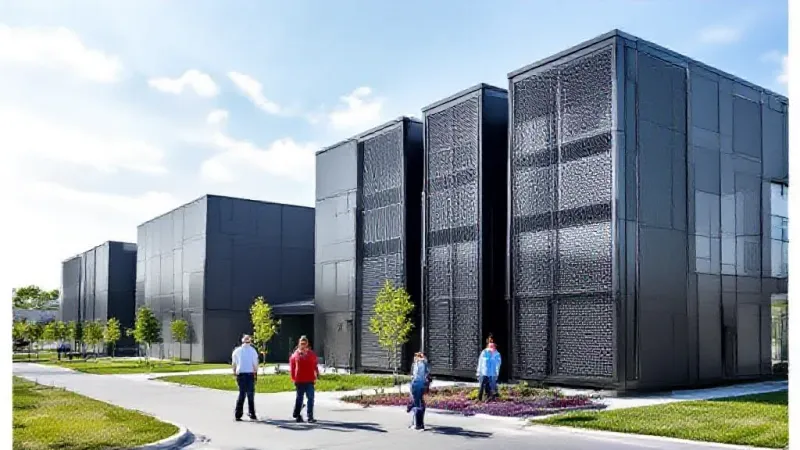
Data centers, which power the growth of artificial intelligence, are rapidly changing the landscape of rural communities across the United States. With all 50 states now home to these large warehouse-like facilities filled with computing technology, companies are expanding capacity at an unprecedented pace. In central Mississippi, Amazon Web Services (AWS) is building two data centers, marking what state leaders have called the largest investment in state history at $10 billion. This expansion brings a surge of economic activity and job opportunities but also raises concerns about utility rates and environmental impact, according to various sources.
TheThe Amazon development in Madison County, Mississippi, currently has five data centers operational and seven more under construction. This project has significantly boosted local businesses. Chad Wages, owner of a local engineering firm, reported his employee count growing from four to 18 since AWS announced its plans. Wages stated his firm specifically handles earthwork components for AWS. He conveyed to his employees that this is a "once-in-a-lifetime opportunity."
The investment could also benefit local education and workforce development. Dwight Luckett, superintendent of the Canton Public School District, indicated that AWS funding might help attract teachers and establish workforce training programs. Luckett suggested such programs could enable high school graduates to enter the workforce directly, earning upwards of "$50,000, $60,000 or more."
However, the job surge from construction is temporary. Once the Madison County site is complete, AWS anticipates roughly 1,000 permanent jobs. Wages acknowledged the temporary nature of the construction boom, stating, "It does. It does. You always have to be looking for the future," when asked about potentially having unneeded employees after construction.
The expansion of data centers also presents significant challenges related to utilities and the environment. These facilities increase carbon dioxide emissions and place pressure on local power grids. The energy required to operate some data centers could power hundreds of thousands of homes. A recent analysis found that between 2019 and 2025, monthly electricity bills for customers located near data centers in Virginia rose more than 267%.
Water consumption is another major concern. A 2025 report from the Environmental and Energy Study Institute indicated that a medium-sized data center can consume approximately 110 million gallons of water annually for cooling purposes, which is equivalent to the water usage of about 1,000 households. AWS plans to use wastewater to cool its facilities in Mississippi.
Abre’ Conner, director of the NAACP’s Center for Environmental and Climate Justice, expressed concerns about the impacts of data centers, noting they often negatively affect already disadvantaged communities. Conner stated that companies need to consider if they would want such facilities next to their own homes. She also cautioned against presenting investments in one part of a community as a solution without addressing broader issues like air pollution and water contamination.
The rapid growth seen in Mississippi is part of a broader national trend. As of spring 2026, Pew Research reported that the U.S. had more than 3,000 operational data centers, with over 1,500 more in various stages of development. A Pew Research analysis also revealed that more than two-thirds, or 67%, of these planned data centers are situated in rural areas, predominantly across the Midwest and Southern regions. Despite the current boom, there is a general concern within the data center market that supply could eventually outpace demand.