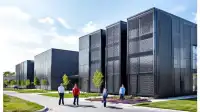

The Ohio Power Siting Board will hold a public hearing today, Thursday, Oct. 22, at 6 p.m. at New Albany High School, regarding the PowerConneX New Albany 3 Energy Center. This facility marks the third major gas combustion plant intended to power an EdgeConneX data center within the New Albany International Business Park.
If approved, PowerConneX 3 would bring the total to seven gas plants powering data centers in the New Albany business park. These seven plants combined would generate 1936 megawatts (MW) of electricity, which is roughly the power demand of over 1.3 million homes.
These seven gas plants have the potential to release 11.9 million tons of greenhouse gas pollution annually. They could also emit 766 tons of fine particulate matter and hundreds of tons each of other harmful pollutants including nitrous oxides, carbon monoxide, sulfur dioxide, volatile organic compounds, and hazardous air pollutants each year. These emissions would occur next to populated areas of New Albany and Licking County.
Fine particulate matter, which is less than 2.5 micrometers in size, is particularly damaging to human health. This pollutant can be breathed deep into the lungs, enter the bloodstream, and cause inflammation throughout the body. Scientific evidence indicates that long-term exposure to fine particulate matter is associated with heart disease, stroke, respiratory illness, asthma, and premature death.
A 2026 study of a 135 MW gas plant powering a data center in Virginia, conducted by a Harvard-affiliated health scientist, found it could lead to $53 million to $99 million in annual health-related damages. These damages include costs from missed work, missed school, hospitalizations, and an estimated 3.4 to 6.5 additional deaths per year in the affected area. The seven gas plants approved and proposed in New Albany have a combined power output 14 times larger than the plant examined in the Virginia study.
Children are particularly vulnerable due to their developing lungs. Almost 13,300 children reside within a five-mile radius of the business park where these seven gas plants are planned to operate.
One reason these data center gas plants are so polluting is their use of less efficient technology. Most utility-grade gas plants employ combined cycle turbines, which generate electricity in two stages. In contrast, the New Albany plants utilize simple cycle turbines, which generate electricity in only a single stage, expelling polluting exhaust and waste heat from a short stack at 800 degrees. The PowerConneX 3 gas plant, specifically, will use 30 reciprocating internal combustion engines. These engines, similar to car engines but significantly larger (longer than a school bus and as tall as a two-story house), are less efficient, requiring more gas to generate the same amount of electricity and thus producing more pollution.
Data centers are installing this more polluting equipment because it is faster to procure and construct. However, increased pollution contributes to accelerated climate change due to greenhouse gas emissions and worsened air quality from pollutants like particulate matter. According to the National Oceanic and Atmospheric Administration, July 2026 was the warmest month on record for the contiguous United States. This past July, the Columbus area recorded its worst-ever air quality index since the Mid-Ohio Regional Planning Commission began tracking records in 1999.
Another concern is the Ohio Power Siting Board’s approval process for gas plants powering data centers. Five plants in the New Albany business park have already been approved, with three receiving approval through an accelerated application process. This accelerated process included no public notice, no public hearing, and automatic approval without a formal vote by board members. For the two gas plants approved through the standard application process, public hearings were held in August and October of last year. However, these hearings saw only two to three individuals offering testimony, all of whom were either oil and gas industry representatives or representatives from unions with members who stood to benefit financially from these projects.
While the first few gas plants in New Albany were approved quietly, area residents are now becoming more aware and expressing opposition. More than 50 people attended a New Albany meeting room on October 6 for the most recent public hearing on the 500 MW NEO Power Generation Facility, which is the fourth gas plant planned to power Meta’s Prometheus data center and the sixth gas plant proposed for the business park. At that hearing, five representatives from the oil and gas industry and unions spoke in favor of NEO, while 20 people, primarily residents of New Albany and surrounding communities, voiced strong opposition to the project. While data centers claim to create jobs and contribute to communities, some believe the economic benefits cannot outweigh the environmental and public health costs resulting from a large build-out of inefficient natural gas technology.