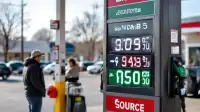

Ohio lawmakers have approved a 90-day suspension of the state’s gas tax, a measure signed into law by the governor on Thursday. The Ohio House of Representatives and the Ohio Senate both approved the suspension on Wednesday. With a two-thirds majority in favor of the bill in each chamber, the legislation takes effect immediately.
The Legislative Service Commission estimates the gas tax suspension will cost the state an estimated $700 million. To cover these lost expenses, the bill itself sets aside $725 million from the state’s General Revenue fund.
While the immediate effect of lower prices at the pump may be welcomed by drivers, a majority of Ohio economists polled do not believe the suspension will provide “meaningful relief” to Ohio households. However, the decision by state legislators does reveal a willingness to allocate $725 million to support households.
One identified weakness of the chosen strategy is that the gas tax suspension only supports drivers. The fuel price hike seen this year due to the War in Iran has driven up costs across the board, impacting even households without cars. Ohio's 370,000 no-car households are left out of the direct benefit, even as they face higher prices themselves. The current gas tax suspension disproportionately benefits two-car households.
Other approaches could have been considered by lawmakers to support Ohio households more broadly, or to target relief more effectively. Price increases, the source notes, are felt differently throughout the population, with low-income households likely feeling the sting of higher prices harder than upper-income households.
One alternative involves a flat household rebate, which could mean each household would receive about $150. Under this approach, no-car households would benefit equally alongside households with three or more cars. Another option could be to target households likely to feel the sting of higher prices harder, such as low-income households. Targeting a rebate to the bottom quintile of households heaviest hit by increases could increase the per-household impact to $760.
Lawmakers could also consider programs for low-income households with children, which are identified as types of households likely to experience the longest-lasting pain from economic shocks. A child tax credit proposal from last year, estimated at $450 million, could provide up to $1,000 per household. This option could offer more meaningful relief to more at-risk households at a lower price than the gas tax proposal.
For lawmakers specifically interested in transportation relief, existing programs could be expanded. County Job and Family Service offices already provide gas cards and bus passes to residents in need. Similarly, transit agencies, such as COTA, have longstanding programs offering discounted transportation fares to people in need. Providing funds for county Job and Family Service offices and local transit agencies could allow them to temporarily expand transit options for low-income workers, concentrating relief in households most affected by rising transportation costs.
Ultimately, lawmakers opted for a “simple, popular solution” this time, leading to a 90-day decrease in gas prices for those who fill up in the state. The decision shows lawmakers are willing to “open their wallets” in times of unexpected price shock, and it suggests they have the opportunity to be “a little more creative” in future situations to help more people at a potentially lower cost.