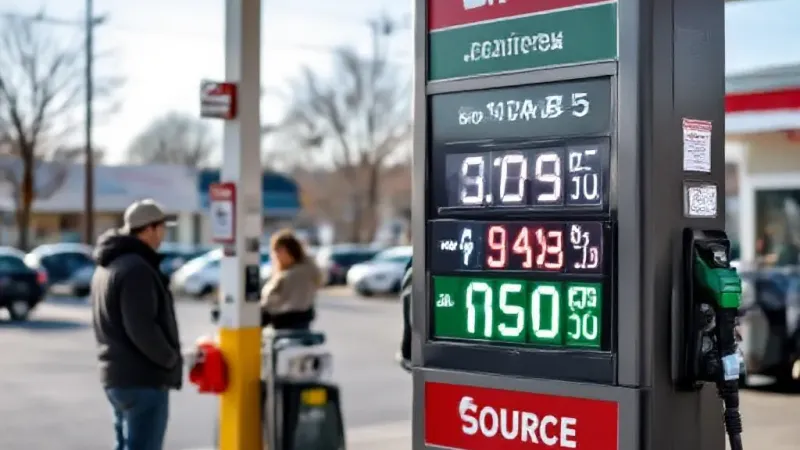
Ohio Republican leadership has scheduled an unprecedented special legislative session for today, Wednesday, to vote on a proposed 90-day suspension of the state's motor fuel tax. The move comes a week before early, in-person voting begins in Ohio. The proposal, championed by Republican gubernatorial candidate Vivek Ramaswamy, aims to temporarily pause the 38.5 cents per gallon tax on gasoline and 47 cents per gallon on diesel. This suspension is projected to cost the state approximately $700 million in lost revenue that typically funds road and bridge work.
Ohio Governor Mike DeWine has voiced strong opposition to the idea of using funds from the Ohio Department of Transportation (ODOT) to cover the shortfall, calling it a “very, very bad idea.” The proposal follows Democratic candidate Dr. Amy Acton's earlier call for an emergency state gas tax holiday to help alleviate consumer costs at the pumps, which she attributed to "Trump's war of choice with Iran." Ramaswamy announced his similar 90-day gas tax suspension plan about six hours after Acton's proposal. Ohio Senate President Rob McColley, who is Ramaswamy's running mate, and Ohio House Speaker Matt Huffman have supported the move in their respective chambers.
The legislative push occurs as Ramaswamy, the Republican nominee, reportedly struggles to gain momentum in the governor's race against Dr. Amy Acton, the former head of the Ohio Department of Health under Governor DeWine. Current polls indicate Acton holds a slight edge over Ramaswamy. This marks the second time the Republican-controlled General Assembly has rallied to support Ramaswamy's campaign with hurried legislation. Previously, Ramaswamy called for Ohio’s voter ID law to become a constitutional requirement. In response, Republicans quickly passed a resolution in three weeks to place a voter ID amendment, which reportedly polls favorably, on the November ballot.
Ramaswamy is a 41-year-old billionaire venture capitalist who made his fortune in biotech. He co-founded a company that moved from Columbus to Dallas two years ago. Ramaswamy has never served in public office and spent tens of millions of his own money on a brief presidential campaign before endorsing Donald Trump in 2024. Despite being passed over by Governor DeWine for a U.S. Senate appointment, Ramaswamy has positioned himself to run for governor in 2026, while also eyeing a future presidential bid. His previous federal advisory role included co-leading an initiative known as the Department of Government Efficiency (DOGE), which reportedly resulted in billions of dollars in paid leave and related expenses for the federal government in an attempt to shrink the workforce.
The legislative actions are seen as an example of the power ceded to an unelected candidate. The source material indicates a pattern where party loyalty and protecting a party boss take precedence in both federal and state legislative bodies. Republican supermajorities in the Ohio House and Ohio Senate, much like their federal counterparts, have been described as prioritizing political allegiance over constitutional duties and legislative prudence. This dynamic is noted as particularly astonishing given the extent of power given to Ramaswamy, who has not been elected to any public office.
Described as "easy politics" and a "last-ditch effort" to alter the trajectory of a gubernatorial campaign that many initially assumed would be easily won, the gas tax proposal and the previous voter ID amendment represent significant legislative actions driven by a candidate. Whether these efforts will sway the electorate as voting begins remains to be seen.