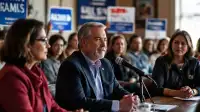

Ohio’s U.S. Senate candidates have shared their perspectives on how to address the future of Social Security, a program facing significant financial challenges in the coming decade. Without Congressional intervention, the Social Security and Medicare Board of Trustees reported in June that the program’s reserves are projected to be depleted by 2032. This would mean that continuing program income would be sufficient to pay only 78% of total scheduled benefits.
The potential reduction in benefits carries a substantial impact for Ohio residents. The Committee for a Responsible Federal Budget estimates that such a reduction would lead to more than 2 million Ohioans losing an average of $487 each month, costing the state $12.1 billion annually starting in 2032. AARP Ohio highlights that the program currently keeps over 700,000 Ohio seniors out of poverty, with the average recipient in Ohio receiving about $1,900 a month in benefits.
Former U.S. Sen. Sherrod Brown, a Democrat, was the more specific of the two candidates in outlining a fix for the program’s solvency. Brown stated that “to ensure that Social Security benefits are there for future generations, we need to ensure that billionaires are paying their fair share by raising the tax cap so we can extend the life of the program.” This proposal involves applying the Social Security tax, currently levied on the first $184,000 of income, further up the income scale. While experts with the Committee for a Responsible Federal Budget, including senior vice president Mark Goldwein, call this measure “the most popular, most commonly discussed plan,” they also indicate it would close only 50% of the solvency gap and delay insolvency by 22 years if current benefit rules remain unchanged.
Brown also highlighted his past actions, touting the Social Security Fairness Act, which he co-sponsored. This law, signed by then-president Joe Biden in January 2025, ended prohibitions against 2.8 million Americans receiving Social Security benefits, including restoring full benefits to 250,000 Ohioans like teachers, firefighters, and police officers. Brown added that he will “always oppose Wall Street’s efforts to privatize Social Security,” in an apparent reference to President George W. Bush’s 2005 attempt. Some critics, however, pointed out that Brown’s championed law further drained the trust fund and primarily benefited workers with government pensions rather than those who paid into Social Security.
U.S. Sen. Jon Husted, a Republican, expressed his commitment to protecting Social Security, describing it as “a sacred promise to our seniors.” Husted stated he was proud to support a $6,000 tax deduction for seniors receiving Social Security, included in the Working Family Tax Cut Act. This act, also known as President Donald Trump’s One Big Beautiful Bill Act, provided $1 trillion in tax cuts to the wealthiest 1% of Americans over 10 years and added an estimated $3.4 trillion to the federal deficit over the same period. The bill also included cuts of nearly $1 trillion from Medicaid over 10 years and $186 billion from the Supplemental Nutrition Assistance Program (SNAP). Approximately 260,000 Ohio seniors were on Medicaid in 2025, and 256,000 were on SNAP in 2022.
Husted did not offer a specific fix for Social Security’s long-term solvency, stating that he stands “ready to work with my colleagues on both sides of the aisle to work to ensure that Social Security remains strong and reliable for all Ohioans.”
The Committee for a Responsible Federal Budget advocates for a bipartisan committee to develop a range of long-term solutions. Potential measures include capping benefits for the wealthiest recipients, using different systems for cost-of-living adjustments, and replacing employer Social Security and Medicare contributions with a flat tax on all compensation, including high CEO pay. This last proposal is projected to raise more revenue than simply raising the tax cap, according to the committee.
Jenny Carlson, AARP Ohio State Director, emphasized the organization’s stance on protecting benefits. She noted in an email that AARP Ohio's role is to ensure members of Congress understand that the solvency discussion is about money people have earned and the high stakes involved if Congress does not deliver for the American people.
The American Association of Retired Persons released a voter guide for the Nov. 3 midterm election, which included video segments of both candidates addressing these issues.