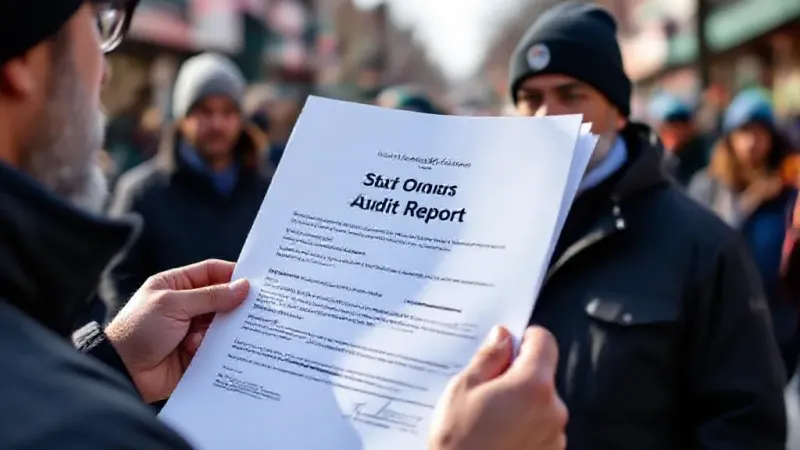
A new state audit of the Public Utilities Commission of Ohio (PUCO) has raised concerns about how the agency manages its staff and finances, and highlighted deficiencies in pipeline safety penalties. Auditor of State Keith Faber announced the findings, noting that the agency, responsible for setting electricity and natural gas rates for Ohioans, does not adequately track the amount of staff labor invested in its cases.
Auditor of State Keith Faber highlighted the significant impact of PUCO's daily decisions on Ohioans' finances, emphasizing that too much is at stake for the commission to ignore readily available analytical tools.
Auditors found that PUCO maintains significantly more money in reserve than recommended levels and that Ohio's maximum fines for natural gas pipeline safety violations are among the lowest nationwide. These findings come as Ohio anticipates a 56% increase in peak electricity demand over the next two decades, driven by data centers and other large power users. Auditors warned that this surge in demand will likely intensify PUCO’s workload, making it crucial for the agency to understand its staffing needs.
The audit did not conclude that PUCO is understaffed, but rather that the commission lacks sufficient information to determine if it has the appropriate number of employees to manage its responsibilities. While PUCO's case-tracking system logs filings and other documents, it fails to consistently link key operational steps with the staff resources utilized to complete them, according to auditors. Essential information, such as the hours employees dedicate to specific parts of a rate case, is not available. This data gap makes it challenging to assess whether additional staff would expedite cases, if current employees could handle more work, or where extra resources might be most beneficial.
Financially, the audit revealed that PUCO holds substantially more money in reserve than recommended. The commission does not receive funding from the state’s general fund; instead, its budget largely comes from assessments and fees paid by the utilities and businesses it regulates. Auditors found that all seven of PUCO’s dedicated-purpose funds held reserves "far in excess" of recommended amounts. From 2020 through 2025, the commission consistently had enough cash on hand to cover at least a full year of operating expenses, and in some years, more than 18 months’ worth. Auditors cautioned that maintaining excessive fund balances "may add unnecessary costs to end users of a good or service" because these reserves are ultimately derived from fees. The report recommended that PUCO establish both minimum and maximum targets for its reserve funds.
Another issue identified by the audit, which falls outside PUCO’s direct control, concerns Ohio’s natural-gas pipeline safety fines. Ohio law dictates the maximum penalties the commission can impose for violations, and auditors determined these limits are among the lowest in the United States. Federal safety standards have increased over time, but Ohio’s limits have remained fixed in state law. If Ohio's limits fall too far behind federal requirements, it could jeopardize the federal certification that permits PUCO to enforce pipeline safety rules, potentially reducing Ohio's authority over local pipelines.
Finally, auditors noted that PUCO lacks a formal strategic plan detailing its priorities, methods for achievement, and success metrics. While not unique among utility regulators—the audit found 13 of 32 states with regulated utility markets had publicly available strategic plans, while 19 did not—this absence raised concerns. Auditors suggested a written plan, linked to PUCO’s budget, would assist the commission in allocating staff and funds, especially as Ohio’s energy landscape evolves.
PUCO officials informed auditors that they are actively working to address these issues. The commission stated it has adopted a new policy for managing its reserves and is nearing completion of a formal strategic plan. Furthermore, a modernization of its case-tracking system is expected to provide more detailed information on workload and staffing. PUCO also reported adding employees and reorganizing departments to prepare for new deadlines established by House Bill 15, an energy law enacted in 2025. The commission confirmed it has met all new deadlines for power-siting cases thus far and that five pending utility rate cases are on schedule.
Legislative reactions to the audit were varied. State Rep. Tristan Rader, a Lakewood Democrat and the ranking member on the House Energy Committee, acknowledged "meaningful change" at the commission under Chair Jenifer French. Rader stated that while progress deserves recognition, the report makes clear that significant work remains. Conversely, Sen. Brian Chavez, a Marietta Republican, said the report "validates the faith legislators have in that agency." He further noted that Ohioans should feel confident in PUCO's systems and procedures for utility regulation. Rader recommended that the legislature increase Ohio’s maximum pipeline safety penalties, considering automatic updates aligned with federal standards.