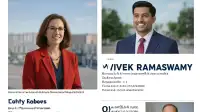

The Ohio Election Integrity Unit, operating under the Ohio Secretary of State’s Office, last month issued a finding of “no violation” regarding Vivek Ramaswamy’s campaign credit card reporting. Ohio state Sen. Kent Smith, D-Euclid, who filed the complaint that initiated the review, stated he is weighing an appeal to the decision.
The issue stems from Ramaswamy’s campaign practices, which the Ohio Capital Journal reported in June involved nearly half a million dollars racked up on a credit card without detailed expenditure reports. State law mandates campaigns report what they spent, who they paid, what was purchased, and when these transactions occurred. Ramaswamy’s campaign, starting with its initial campaign finance report in 2025, had obscured these details by reporting monthly campaign expenditures as a single credit card reimbursement. These amounts grew significantly, from about $6,700 on its American Express card in April 2025 to over $96,000 in a single month a year later.
Following public scrutiny, Ramaswamy’s team revised its campaign finance reports. Expenditures previously listed as a single credit card reimbursement are now broken down into individual line items. The secretary’s office also fulfilled a public records request for supporting documentation related to the campaign’s reports.
Despite these revisions, Senator Smith expressed continued concerns. He points out that while the revised reports now list payees and amounts, they record these transactions on the date the campaign paid its credit card statement, rather than the date each transaction actually occurred. Smith also indicated frustration that the secretary’s office has not yet responded to his request for correspondence with the Ramaswamy campaign. Smith suggested two possible conclusions: either Ohio Secretary of State Frank LaRose is allowing the candidate to “skate on the rules,” or LaRose’s office is attempting to bring Ramaswamy into compliance, and the campaign is “completely ignoring it.” Smith added that correspondence between the offices would satisfy his “curiosity” on the matter.
The Ohio Capital Journal first highlighted the campaign’s unusual credit card use in April, ahead of the primary election, and filed a public records request with the Secretary of State’s office. The reporting pattern continued through the post-primary campaign finance report in June. In response to subsequent requests for records and questions about efforts to correct the reporting, the secretary’s office provided supporting documents in August but did not answer the Capital Journal’s specific questions. Senator Smith filed his complaints after the Capital Journal’s story, concurrently requesting the correspondence. He described receiving pushback from the secretary's office, informing him that Ramaswamy’s team was correcting its reports. On September 16, Smith received the “no violation” finding from the Ohio Election Integrity Unit.
The Ohio Election Integrity Unit operates within the secretary’s office, a structure that differs from the politically independent Ohio Elections Commission, which Republican state lawmakers eliminated. The new unit now functions under the partisan elected office of the Secretary of State. The finding letters received by complainants explicitly state the secretary’s role, noting that “the Election Integrity Unit has recommended, and the Secretary of State adopted, the following finding(s).” Secretary of State Frank LaRose, who is currently running as the Republican candidate for state auditor this November, has endorsed Ramaswamy and appeared alongside him at several campaign events.
Catherine Turcer, representing the government watchdog group Common Cause Ohio, indicated she sees no issue with the unit’s finding. Turcer explained that a primary goal of campaign finance law is to ensure committees fix reporting problems, rather than solely penalizing them. She believes it makes sense for the Secretary of State’s office to alert campaigns promptly and work to obtain information quickly so that voters have timely access to it, contrasting this with a previous system where decisions could take a year or more. Turcer also stated she has no immediate issue with the secretary’s role in the decision-making, appreciating the clarity that “the secretary of state is deciding.”
However, Turcer did identify a concern: “it’s not clear that the person who complained can actually appeal this to the commission.” While lawmakers replaced the Ohio Elections Commission with a new five-member Ohio Election Integrity Commission, which has the final say if a complainant appeals, the letter Smith received made no mention of an appeal process. Instead, it advised “no further action is needed from you” and provided contact information for questions.
For Senator Smith, the broader implication of the reporting gaps is as concerning as the gaps themselves. He acknowledged that campaigns can lose receipts but argued that when a problem “gets egregiously worse,” it suggests that the issue was never truly corrected. He attributes this to either a failure of the Secretary of State's office to instruct the Ramaswamy campaign properly, or the campaign actively ignoring those instructions. Smith confirmed he is “considering every additional option” regarding the decision but has not yet formally appealed.