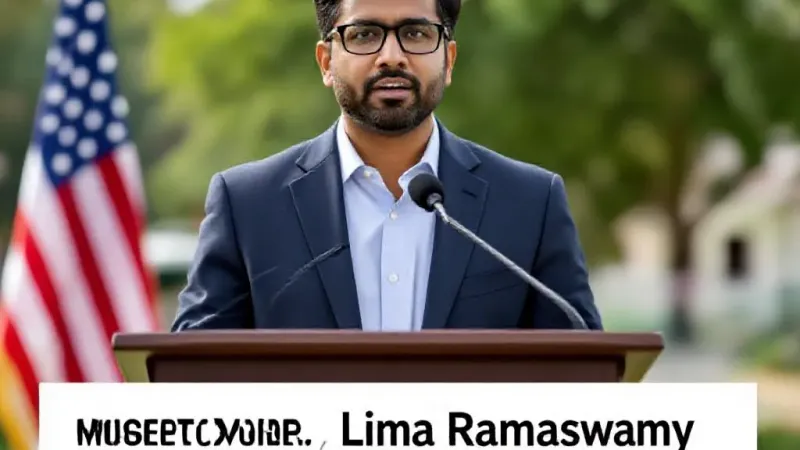
Republican candidate for governor Vivek Ramaswamy discussed his policy plans for Ohio, including tax cuts, the death penalty, medical freedom, and Second Amendment rights, during an appearance in Columbus on Wednesday. Ramaswamy spoke at a Columbus Metropolitan Club meeting held at the National Veterans Memorial and Museum.
Ramaswamy committed to respecting the Second Amendment "to the fullest extent" and advancing "medical freedom." He also stated his intention to resume death penalty executions in Ohio.
Columbus Metropolitan Club CEO & President Sophia Fifner explained that both gubernatorial candidates had been invited to participate in CMC forums. However, Democratic candidate Dr. Amy Acton has not agreed to an appearance. The Ohio Capital Journal, which reported on the event, reached out to Acton’s campaign regarding the invitation and Ramaswamy’s comments but did not receive an immediate response.
Addressing Ohio's property tax situation, Ramaswamy told attendees that the issue's root cause was government spending following the COVID-19 pandemic, rather than local levies or expanding district budgets. He characterized the increased value of homes on paper as a "financial curse," saying that while home values rose, Social Security, pension, and wage payments remained flat.
Ramaswamy proposes rolling back Ohio's property taxes to pre-pandemic levels. He acknowledged that property tax rates are generally set at the local level and support a variety of services, including schools, first responders, and libraries. Estimates suggest such a rollback could cost $4 billion. However, Ramaswamy insisted that vital services would not suffer, suggesting that property tax reform could lead to a reconsideration of statewide funding for services traditionally reliant on local property taxes. Statehouse News Bureau Chief Karen Kasler, who moderated the event, pressed Ramaswamy on how he would fund the estimated $4 billion.
In response, Ramaswamy referenced state lawmakers' recent move to cut income taxes to a flat 2.75% rate. He stated that Ohio's budget is running a $1.6 billion surplus relative to prior projections, attributing this to economic growth resulting from the tax cut. He argued this surplus provides the flexibility to fund initiatives like a gas tax holiday through the end of the year and could support his property tax plan.
Ramaswamy also reaffirmed his commitment to capital punishment in Ohio, stating his intent to resume executions "in the rare cases for the most egregious of crimes." This comes after Ohio Governor Mike DeWine implemented a de facto moratorium on capital punishment since taking office, explaining in June that the moral justification for the death penalty "no longer exists" due to an inability to prove it acts as a deterrent.
Following a recent botched execution in Tennessee, Ramaswamy called such failures "unacceptable." He pledged that Ohio would carry out sentences in an "ethically appropriate, scientifically sound, effective, and swift" manner. He noted limitations in Tennessee's single-drug protocol compared to Ohio's existing three-drug protocol, which uses drugs whose specific identities are confidential under state law. Asked by Kasler about changing Ohio's execution methods amid concerns about expiring lethal injection stockpiles and limited options for replenishment, Ramaswamy stated, "we’re studying this," indicating an openness to methods other than lethal injection that "have been successfully used in the past." The U.S. Supreme Court denied Alabama's request in June to use nitrogen gas for an execution, leaving a lower court's ruling against the method in place.
On the Second Amendment, Ramaswamy argued that if 18-year-olds are old enough to serve in the military and carry firearms, they should be able to purchase firearms. Ohio law already allows active or reserve members of the armed forces, as well as honorably discharged individuals, to purchase handguns at age 18, an exception granted in 2008.
Ramaswamy also addressed medical freedom, supporting "Right to Try" legislation. He believes patients with terminal or life-threatening conditions should be able to access investigational therapies in consultation with their physicians. Ohio approved similar "Right to Try" legislation in 2016, allowing terminally ill patients to receive investigational drugs or products that have completed phase one trials.