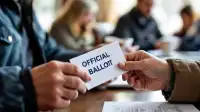

Former Democratic U.S. Sen. Sherrod Brown secured a return to Washington late Tuesday night, defeating appointed Republican incumbent U.S. Sen. Jon Husted in a high-stakes special election for Ohio’s seat in the U.S. Senate, as Ohio Capital Journal reported. The Associated Press officially projected Brown as the winner at 11:11 p.m. on election night. Husted had taken office at the beginning of 2025 after Ohio Gov. Mike DeWine named him to complete the term left open when former Sen. JD Vance assumed the vice presidency. The projected victory occurred amid a broader string of victories for Democratic candidates across the country, fueled in large part by widespread voter dissatisfaction with Republican President Donald Trump.
Although Husted brought a 25-year career in state politics to the contest, his campaign unfolded within a fiercely nationalized political climate. Throughout the race, opponents scrutinized Husted’s legislative record and key policy positions. Records showed Husted voted in favor of measures that proved unpopular with many voters, including tax cuts aimed at wealthy individuals, broad reductions to healthcare funding, and continued protections for tariffs backed by Trump that numerous economists warned had escalated inflation. Additionally, Husted cast votes against releasing the Epstein files and voiced support for military action regarding the war in Iran.
During the campaign, Brown repeatedly attacked Husted's ties to corporate interests, describing his opponent as an out-of-touch tool of wealthy figures and characterizing him as the face of data centers across the state. Brown heavily emphasized Husted’s connection to a massive state bribery scandal involving Akron-based utility company FirstEnergy. In that case, FirstEnergy paid $61 million in illicit bribes to secure a $1.3 billion bailout funded by Ohio ratepayers. Brown highlighted the fact that Husted was called to testify in a criminal trial to defend utility executives who faced indictment in connection with the largest public bribery scandal in Ohio history.
Despite Brown's overall success across the state, academic analysis indicated his winning coalition relied primarily on urban and suburban shifts rather than gains in rural communities. Lee Hannah, a political scientist at Wright State University, stated that data from the election did not show Brown picking up additional support in rural areas of Ohio. Instead, Hannah observed that Brown built his winning margin by expanding his support by roughly 5% across several key suburban counties and major cities, where lower rural voter turnout helped preserve those suburban leads.
Looking ahead, Hannah noted that because this contest was a special election to complete an unfinished term, Brown will face voters again in just two years. Hannah explained that during his upcoming two-year stint in the Senate, Brown could focus on legislative efforts aimed at addressing economic pressure and rising living costs. If federal lawmakers work to turn around pressing affordability issues and demonstrate tangible results for working families, Hannah suggested the senator might find opportunities to rebuild political support among voters in rural communities who favored his opponent in this cycle.
The path to Tuesday's special election was heavily shaped by decisions involving Trump and key leaders in Ohio politics. When Trump selected Vance as his vice presidential running mate during the 2024 presidential campaign, he created a vacancy in a Senate seat that originally had four years remaining on its term. Had Vance remained in the Senate, Ohio voters would not have had a U.S. Senate election on their ballots on Tuesday.
The timing of the vacancy also reshaped the field for state offices. Prior to the appointment, then-Lt. Gov. Husted and then-Ohio Attorney General Dave Yost had spent considerable time competing for the upcoming governor's race following DeWine’s planned retirement in January. However, when Trump issued an endorsement for Cincinnati billionaire Vivek Ramaswamy in the gubernatorial contest, both Husted and Yost stepped aside from that primary. DeWine subsequently selected Husted to fill the vacant Senate seat, leading directly to Tuesday’s general election matchup in which both Husted and Ramaswamy ultimately suffered losses in a state that had trended increasingly Republican in recent election cycles.
Brown, 73, brings decades of public service experience to the Senate seat. Born in Mansfield, Brown earned an undergraduate degree from Yale University before completing a master’s degree at Ohio State University. His political career in Ohio began as a state representative from 1975 to 1982, followed by two terms as Ohio secretary of state from 1983 to 1991. He then represented Ohio in the U.S. House of Representatives from 1993 to 2007. Brown first won election to the U.S. Senate in 2006, when he defeated Republican incumbent Sen. Mike DeWine during another midterm election marked by an unpopular Republican president.
Because of those historical parallels and the high stakes involved, both political parties treated the race as a tight contest from the moment Brown announced his candidacy. Campaign spending reached historic levels, with media monitoring outlet The Hill reporting last week that total expenditures on television advertising and future ad reservations had surpassed $500 million by late October. That total made the Ohio Senate battle the second-most expensive race of the current election cycle and placed it among the 10 most expensive non-presidential elections in U.S. history.